
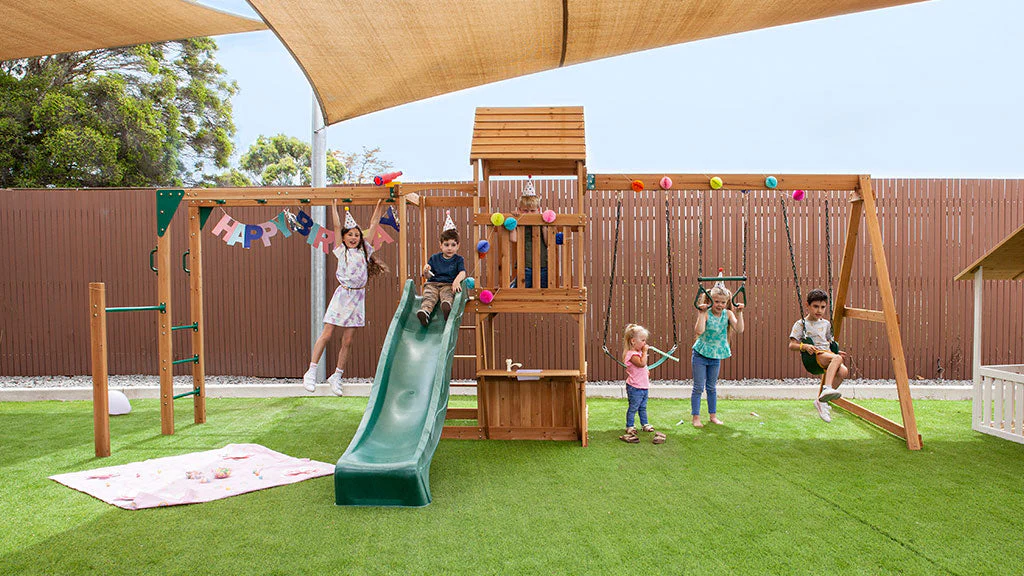
Australian kids are spending more time indoors than ever before. Research consistently shows that children who play outside regularly develop stronger physical fitness, better social skills, and greater resilience — yet screen time continues to creep upward across the country. The good news? You don’t need a sprawling property or a massive budget to bring outdoor play back to life. A thoughtfully designed backyard play space can do it all.
Whether you’re starting from scratch or upgrading what you already have, here’s how to create an outdoor setup that genuinely gets kids moving, exploring, and away from the couch.
Start with the right equipment for your space
The biggest mistake parents make is buying individual pieces of equipment without thinking about how they’ll work together. A backyard play space is most effective — and most used — when the different elements complement each other and suit the age ranges of the children who’ll be using it.
For younger children aged two to seven, kids’ slides are often the first major addition to any play space. They’re accessible, confidence-building, and universally loved. Look for slides with wide steps, sturdy handrails, and UV-resistant materials if they’ll be sitting in full sun through the Australian summer.
As children get older and more adventurous, you’ll want equipment that challenges them physically. This is where planning pays off — choosing pieces that grow with your kids rather than needing replacement every few years.
The case for a cubby house as the centrepiece
If there’s one piece of equipment that transforms a backyard from ordinary to extraordinary, it’s a cubby house. Kids don’t just play in a cubby — they create entire worlds inside it. It becomes a shop, a spaceship, a fortress, and a hideout, depending on the day.
A well-built cubby house does more than provide imaginative play space. It encourages cooperative play between siblings and friends, provides a sense of ownership and independence for children, and often comes with built-in features like climbing walls, ladders, and platforms that add physical challenge.
When choosing a cubby, think about the footprint relative to your yard, the height that’s appropriate for your children’s ages, and whether you want it freestanding or integrated with other equipment. Timber models tend to blend beautifully with Australian gardens; powder-coated steel structures offer impressive durability in coastal or high-humidity areas.
Add a flying fox for pure, unbeatable fun
Few things produce the kind of shrieking, running-back-for-more joy that a flying fox does. It’s one of those pieces of equipment that appeals across a huge age range — from a six-year-old gripping the handle for the very first time to a twelve-year-old who’s built up enough momentum to make it genuinely thrilling.
From a development perspective, flying fox playground equipment builds grip strength, core stability, and spatial awareness. It also encourages risk assessment — kids learn quickly how to judge momentum, timing, and body position. These are skills that don’t come from a screen.
Before installing a flying fox, check the available run length in your yard. Most residential models work well in backyards from around eight metres onwards. The landing zone at each end needs to be clear of obstacles and ideally have some softfall material like rubber mulch or sand beneath it.
Why swing sets remain a backyard essential
There’s a reason swing sets have been a staple of Australian backyards for generations. Swinging is rhythmic, calming, and deeply enjoyable — it’s one of the few activities that children of almost any age can do together on the same structure, from toddlers in a cradle seat to teenagers on a standard belt swing.
Modern swing sets have come a long way from the basic two-seat frames of the past. Many now include trapeze bars, gym rings, rope ladders, and combination frames that let you swap attachments as children grow. Some integrate directly with cubby house platforms, creating a multi-level play structure that maximises the use of your yard’s footprint.
When choosing a swing set, pay attention to the maximum weight rating, the spacing between seats, and whether the frame is anchored or freestanding. In areas with sandy soil, anchor kits are particularly important for stability.
Pulling it all together
The most successful backyard play spaces share a few common traits: they’re designed with safety in mind, they offer variety so children don’t get bored, and they’re built from materials that can handle the Australian climate.
It’s worth spending time at the planning stage thinking about flow — how children will move from one piece of equipment to the next. A cubby house with a slide off the side, a flying fox running the length of the yard, and a swing set at the other end creates a circuit that keeps kids moving and engaged for hours.
Softfall surfacing under and around equipment is non-negotiable. Rubber mulch, play sand, and certified softfall rubber tiles all provide protection from falls and hold up well through wet winters and dry summers.
Finally, involve your kids in the planning process. When children feel ownership over their play space, they use it more. Ask them what they want, show them options, and let them contribute to decisions where possible. The result will be a backyard they genuinely love — and one that keeps them outdoors where they belong.
